


How much do AI tokens cost businesses?
AI token costs for businesses ranged from a few hundred dollars to hundreds of thousands per month in April 2026, depending on company size, model selection, and how many workflows run on AI. Based on proprietary data from Ramp, the median monthly spend was $2,246. The average monthly spend was $140,842. That gap reflects how AI spend actually distributes: Most companies are in early or moderate adoption, but a single team or automated workflow running unchecked can move you from the median into the average range.
Ramp processes AI vendor payments on behalf of thousands of businesses, giving the company direct visibility into what companies actually paid to Anthropic, OpenAI, and other providers. In this article, Ramp outlines what AI tokens currently cost businesses. Unlike most benchmarks, which are built from vendor pricing pages, the figures below reflect observed effective rates from recent data, across real usage patterns, model mixes, and volume.
Per-employee-per-month (PEPM) AI spend is the most useful benchmark for budgeting and comparison. That range spans a 20 times cost difference: The cheapest model (GPT-5-nano) runs 7 cents per million tokens, while GPT-5.5 costs $1.42. Model selection is now one of the biggest procurement decisions you'll make.
What AI tokens actually cost: A business benchmark
Every time an AI model processes a request and generates a response—a query to ChatGPT, a Claude task, an automated workflow step—that's inference. Inference is what you're paying for, and it's billed in tokens.
What you pay depends on two things: which model handled the request, and how much it generated. Providers charge separately for input (what you send) and output (what the model returns). Output costs three to five times more because it takes more computation to produce.
The bigger variable is model tier: Lightweight models are fast and cheap. Premium models are the most capable and most expensive.
Across the businesses Ramp tracks, token costs in April 2026 averaged 72 cents per million tokens (weighted average across model tiers and usage patterns). But that average obscures the real range:

Ramp
What $1,000 buys in tokens: 14,567 million GPT-5-nano tokens, vs. 704 million GPT-5.5 tokens.
Think of it like company travel: The same trip costs economy or business class, except the price difference here is 20 times, not two times. Engineering books the tickets—finance gets the bill. Model tier is now a finance decision.
The spend distribution: Median vs. average
Token unit costs tell you what AI could cost. What you’re actually spending looks different. The distribution is wider than most finance teams expect.
AI spend has the same distribution as household income: The median is what's typical, the average gets pulled up by a small number of heavy spenders. You should benchmark against the median, not the mean:

Ramp
What this means for budgeting: If your AI spend is near the median ($2,246 per month), you're in early-adoption territory, and AI is likely a productivity tool for some teams, but not yet a COGS line item. If you're approaching $14,843 per month (top 25% of AI spenders), AI is becoming a material budget line that warrants monthly review. At $73,030 per month (top 10%) and above, AI spend management is a full-time finance function.
Spend thresholds worth knowing:
- 58% of companies tracked spend more than $1,000 per month on AI
- 31% spend more than $10,000 per month (the level where AI becomes a formal budget line)
- 13% spend more than $50,000 per month
- 9% spend more than $100,000 per month
- 2% spend more than $500,000 per month
Per-employee-per-month (PEPM): The right unit for benchmarking
Per-total-company spend is hard to compare across companies of different sizes. PEPM normalizes for headcount and gives a benchmark you can apply to budget planning. Among companies tracked by Ramp in April 2026, the overall median was $46 PEPM, but the range is wide:
Ramp
The middle 50% of companies fell between $3 and $352 PEPM. This wide range means that PEPM is most useful as a directional benchmark, not a precise target.
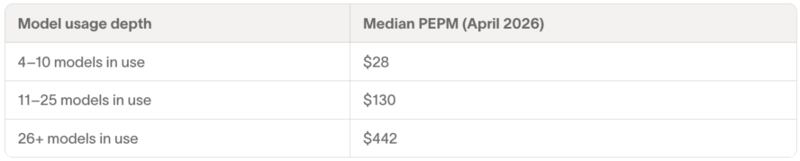
Model count is a strong proxy for AI maturity. The more models you’re running, the deeper AI is embedded in your operations, and the higher your per-employee cost.
Month-over-month AI spend swings of 40% or more are common even with stable headcount, so build in buffer when planning.
What drives AI token spend up
Model tier migration. The single biggest driver of unexpected cost increases. Your teams upgrade from a lightweight model to a frontier model for quality reasons, often without your visibility. The cost change can be 10-100 times.
In April 2026, premium models represented 45.8% of tokens consumed by businesses, but 55.9% of total cost. That gap (more cost from fewer tokens) reflects the pricing premium of higher-tier models. Premium model cost share rose from 5.7% in June 2025 to 55.9% in April 2026, with the category shifting rapidly toward more capable, more expensive models.
Model proliferation. The median business used nine models in April 2026, while the average used 16.5. Among businesses using 26 or more models, median monthly AI spend was $26,562. Complexity is expensive.
Agentic usage. AI agents run like a meter. Each step the agent takes to complete a task generates a separate charge, and the agent decides how many steps to take. You approved the task, but the agent determines the bill.
Automated usage doesn't feel like "using AI" until the invoice arrives. Ask your engineering team: Which workflows run on automated agents, and is there a per-run cost ceiling in place?
Volume growth. From January 2025 to April 2026, token usage among businesses with connected AI grew 1,001%. Spend growth tends to lag usage growth as per-token prices fall—but total spend still grew 497% in that period.
What drives AI token spend down
Every inference request involves choices your engineering team is already making: which model, how much context, how fast. You don’t need to do anything exotic to reduce spend. It’s about making those choices deliberately instead of defaulting to the most capable or convenient option.
Caching. How much caching helps depends entirely on your workflow. Think of it like a photocopy machine: You pay once to set up the document, then copies are cheap. Workflows that reuse the same context (system prompts, static reference docs) achieve 80%-plus cache hit rates. Workflows processing unique inputs each time (new documents, images, fresh conversations) see below 20%.
The cost difference is five times for the same model. In practice: Claude Sonnet 4.6 businesses paid 62 cents per 1 million tokens in April 2026, versus the $3 per 1 million list price. That gap is caching.
Model tier discipline. Ask your engineering team to test your top three AI use cases on a lightweight model before defaulting to a premium one. The cost difference, often 10-20 times, justifies a one-week test. Make model selection a finance-visible decision for any workflow expected to exceed $500 per month.
Context management. Nearly 1 in 5 Anthropic tokens processed in April 2026 were long-context. That's not inherently wrong—some tasks need it. But large conversation histories, oversized system prompts, and redundant document chunks all cost tokens whether or not the model needs them.
The question isn't whether to use long context. It's whether you're choosing it deliberately for each workflow, or just passing everything forward by default.
This story was produced by Ramp and reviewed and distributed by Stacker.